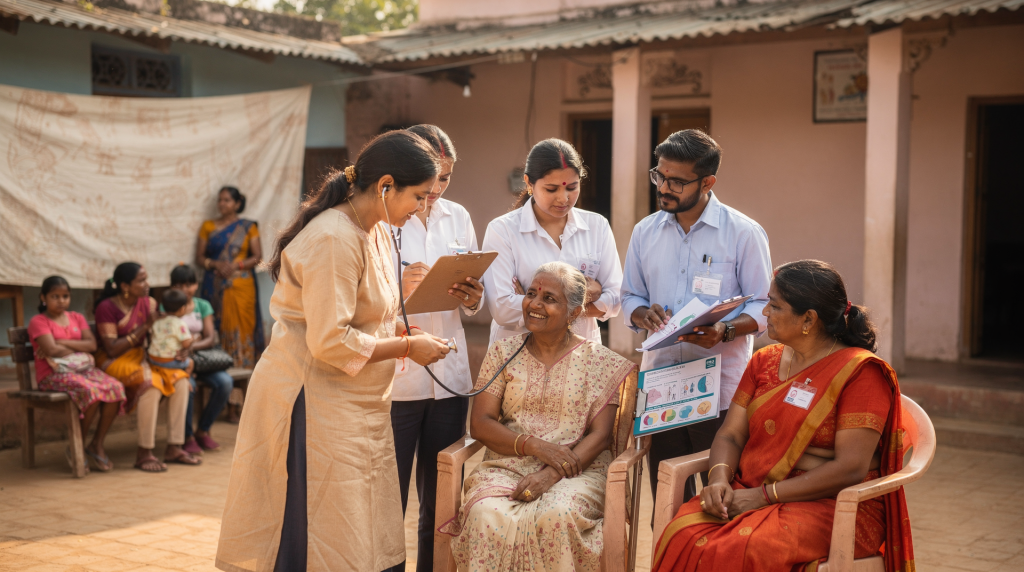
When I first started working with families in rural Maharashtra, I quickly realized that health and housing are inseparable. A family without a stable roof cannot follow a treatment plan, store medicines safely, or maintain the hygiene needed to prevent disease. Over the years, I’ve seen how nonprofit-led community health initiatives do more than just deliver care—they often become the first point of contact for families who are also struggling with housing insecurity. The strongest programs understand this link and build their outreach around it, connecting health support to the broader stability that comes from secure shelter.
Why nonprofit-led community health matters in India
In the context of affordable housing, community health is not a separate issue. It is part of the same struggle. Families living in transitional shelters, informal settlements, or overcrowded rental rooms face constant health risks—respiratory infections from poor ventilation, waterborne diseases from shared facilities, and chronic stress that worsens every existing condition. Nonprofits that work at the intersection of housing and health often step in where government schemes fall short, especially for populations that are not yet eligible for formal housing subsidies or who are stuck in bureaucratic waiting periods.
A well-run community health initiative, when designed with housing awareness, can do three things at once:
- Reach families who are too preoccupied with shelter instability to seek preventive care.
- Reduce avoidable illness through screening and education, which in turn protects a family’s ability to work and save for a home.
- Help families navigate public health entitlements while also connecting them to housing assistance programs—because the two are often administered through separate government departments, and families need help bridging that gap.
What community health initiatives usually include
Most nonprofit health programs in India fall into a few clear categories, but I’ve noticed that the ones with the deepest impact on housing stability are those that intentionally weave in shelter-related support. The exact mix depends on the population served, but the strongest initiatives usually cover several of these areas together.
| Program area | What it means in practice | Why it matters for housing security |
|---|---|---|
| Maternal and newborn health | Prenatal counseling, safe delivery support, postnatal follow-up | Healthy mothers can maintain employment and manage rent; infant health crises often push families into debt or eviction. |
| Child health and immunization | Vaccination support, growth monitoring, nutrition checks | Prevents medical expenses that drain savings meant for a housing deposit or home improvement. |
| Nutrition | Anemia screening, breastfeeding support, malnutrition treatment | Malnutrition keeps adults from steady work, directly affecting a family’s ability to afford stable shelter. |
| Health camps and screenings | Blood pressure, diabetes, eye, dental, cancer or general check-ups | Early detection avoids catastrophic health costs that are a leading cause of housing loss among low-income families. |
| Mental health | Awareness sessions, counseling, referral support | Stress from housing insecurity feeds mental health issues; addressing both together improves outcomes. |
| Hygiene and sanitation | Handwashing, menstrual hygiene, safe water education | Inadequate sanitation in informal housing spreads disease; education helps families advocate for better facilities. |
| Telehealth and referrals | Phone-based guidance, doctor connections, follow-up | Useful where clinics are far away, but also where families have moved due to eviction or relocation. |
| Digital tracking | Records for maternal, child, and chronic care follow-up | Continuity of care is critical when families change addresses frequently—common among those awaiting housing assistance. |
How nonprofits deliver health support on the ground
The most effective nonprofits in India usually combine community outreach with service delivery, and the ones I’ve collaborated with follow a pattern that mirrors good housing case management. A common process looks like this:
- Identify the underserved community through local mapping or partner referrals—often the same neighborhoods where housing is most precarious.
- Build trust with community leaders, schools, anganwadi workers, or local volunteers who already know which families are doubling up or facing eviction.
- Run awareness sessions on a specific health need such as nutrition, maternal health, or hygiene, while also sharing basic information about housing entitlements and subsidy schemes.
- Offer screenings, check-ups, or vaccination drives, sometimes in the very community halls or transitional shelters where families gather.
- Refer high-risk cases to hospitals or public health facilities, and simultaneously flag families who need urgent housing support to partner organizations or government help desks.
- Track whether the person actually received care, and whether their housing situation changed—because a move to a new shelter or a sudden eviction often interrupts treatment.
This follow-up step is often what separates a meaningful program from a one-day event. Without it, many people receive advice but never complete treatment, and the underlying housing instability that caused the health crisis remains unaddressed.
Common models used by nonprofit organizations
1. Mobile health camps
Mobile camps are one of the simplest and most visible models. Teams travel to villages, slums, or remote neighborhoods to provide basic care, screenings, and referrals. In my experience, these camps work best when they are co-located with housing information stalls—families come for a blood pressure check and leave knowing how to apply for a housing grant or where to find a transitional shelter. Transportation is often the same barrier that keeps people from both clinics and government housing offices, so bringing both services to the community saves time and builds trust.
2. Community health worker models
Some organizations train or partner with local workers who stay in the community and check on families regularly. These workers help with pregnancy tracking, childhood nutrition, immunization reminders, and chronic disease follow-up. I’ve seen these same workers become informal housing navigators—they know which families are sleeping in unsafe structures, who is behind on rent, and who qualifies for a subsidy but hasn’t applied because the paperwork is overwhelming. Their consistent presence makes them a bridge between health and housing support.
3. Public-system partnership models
Many nonprofits do not replace government health services; they help people use them better. This can include assisting with referrals, strengthening outreach, or improving community awareness around entitlement-based care. The same model applies to housing: the best nonprofits don’t build homes themselves but help families access existing government schemes like Pradhan Mantri Awas Yojana or state-level rental assistance. They demystify the application process, gather documents, and follow up with officials—tasks that are often too daunting for a family already stretched thin by health and income challenges.
4. Specialized care programs
Some nonprofits focus on one high-need area such as pediatric cardiac care, eye health, maternal care, or vaccination drives. These targeted programs can save lives where specialized treatment would otherwise be inaccessible. When such a program is linked with a housing support network, the impact multiplies: a child who receives heart surgery can recover in a stable home rather than a crowded shelter, and the family avoids the downward spiral of medical debt and eviction.
What makes a strong nonprofit health program
A community health initiative is usually effective when it has these features—and I’ve found that the same criteria apply to housing-focused programs:
- Clear target group, such as pregnant women, children, adolescents, or elderly residents—often the same groups most vulnerable to housing discrimination.
- Local trust, built through repeated contact rather than one-off visits. Trust is the currency that allows a health worker to also ask about a family’s living conditions without causing offense.
- Referral links to real hospitals or clinics, and equally real connections to housing assistance offices, legal aid for eviction cases, or emergency shelter providers.
- Data tracking for follow-up and outcomes, including housing status as a social determinant of health.
- Health education that matches local language and culture, and that acknowledges the housing realities of the audience—for example, explaining how to store medicines safely in a one-room dwelling.
- Measurable goals, such as screenings completed, immunizations delivered, or pregnancies tracked, alongside indicators like families stabilized in permanent housing after intervention.
Programs that only distribute pamphlets or run occasional camps usually have limited impact. Programs that combine education, access, and follow-up—and that recognize housing as a health issue—tend to produce better results.
Typical challenges nonprofits face
Even strong initiatives run into practical problems, and many of them mirror the obstacles families encounter when trying to secure affordable housing:
- Low awareness: People may not know a service exists, whether it’s a free health screening or a government subsidy for home construction.
- Distance: Clinics and hospitals may be too far away, just as housing offices are often located in district headquarters that require expensive travel.
- Cost: Even small travel or medicine costs can stop care, and similarly, the incidental expenses of gathering documents for a housing application—photocopies, notary fees, transport—can derail the process.
- Social barriers: Women, migrants, or marginalized groups may delay seeking help for both health and housing due to fear of discrimination or lack of documentation.
- Follow-up gaps: Patients may attend once but not continue treatment; applicants may start a housing form but never submit it because they don’t receive reminders or support.
- Coordination issues: Referrals can fail if the public system is overloaded, and housing applications can stall if the relevant department doesn’t communicate with health or social welfare offices.
Understanding these barriers is important because the best solutions are usually practical, not abstract. For example, transport support, reminder calls, or a local volunteer network can sometimes improve outcomes more than a large awareness campaign—and the same volunteer who reminds a mother about her child’s immunization can also help her collect the income certificate needed for a housing subsidy.
How families can benefit from nonprofit health initiatives
If a family lives in an underserved area, a nonprofit health program can help in several concrete ways—and when that program is housing-aware, the benefits extend even further:
- Free or low-cost screening for common conditions, which protects the family budget from unexpected medical shocks that could lead to rent default.
- Guidance on pregnancy, newborn care, and child nutrition, delivered with an understanding of the cramped, shared spaces many families call home.
- Vaccination support and awareness, reducing school absences and helping parents stay employed.
- Referrals to hospitals or specialty care, often accompanied by help with transport or paperwork—the same skills that can be used to navigate a housing application.
- Help understanding public health entitlements, and increasingly, information about housing schemes that the family may not know they qualify for.
- Health education in a local, easy-to-understand format that respects the family’s living situation and doesn’t assume access to private bathrooms or kitchens.
This is especially valuable in India, where families may know they need care but still struggle with where to go, how to get there, and what to do next—and where the same confusion applies to housing assistance programs that could change their lives.
Checklist: how to evaluate a nonprofit health initiative
Before trusting or partnering with a program, check whether it has:
- A clear health focus, not just vague “community welfare,” and ideally an awareness of how housing conditions affect health outcomes.
- A defined service area and target population—often the same neighborhoods where housing nonprofits are active.
- Qualified medical or public health partners, and preferably relationships with housing agencies or legal aid providers.
- Referral pathways for serious cases, including a protocol for when a patient’s housing situation is a barrier to recovery.
- Follow-up after screening or treatment, with staff who understand that a change of address is common and doesn’t mean the family should be lost to follow-up.
- Local language communication that includes housing-related vocabulary families actually use.
- Transparency about outcomes and program scope, including whether they track housing stability as a secondary outcome.
- Community involvement, not top-down delivery only—because the community knows best which families are silently struggling with both health and shelter.
Practical examples of program focus areas
Nonprofit organizations in India commonly work in areas such as:
- Maternal and newborn health support, often delivered in neighborhoods where women also need help accessing widow pension or single-mother housing schemes.
- Immunization and childhood nutrition, which keep families from falling into the debt traps that lead to eviction.
- Preventive screening through camps and mobile units, which can double as opportunities to distribute information about housing grants and subsidy deadlines.
- Eye care and other specialized access programs, where restoring vision can mean restoring a breadwinner’s ability to work and pay rent.
- Health literacy and hygiene education, which is most effective when it acknowledges the reality of shared taps and lack of private sanitation in informal housing.
- Digital community health tracking for better follow-up, a system that can also flag families who have moved or become homeless.
These examples show that community health is broad. The strongest organizations usually combine prevention, access, and continuity rather than focusing on only one intervention—and they increasingly see housing as part of the health continuum.
FAQ
What is a community health initiative?
It is a program that improves health at the community level through prevention, education, screenings, referrals, and ongoing support rather than only hospital-based treatment. In practice, the most effective ones also address the housing conditions that make people sick in the first place.
Why are nonprofits important in community health in India?
They help reach underserved families, especially where access, awareness, or follow-up is weak. Many of these families are also invisible to formal housing programs, so nonprofits become a critical link between health and shelter support.
Do nonprofit health programs replace government healthcare?
No. The best programs complement public systems by improving access, awareness, and continuity of care. Similarly, they don’t replace government housing schemes but help families navigate the bureaucracy and paperwork required to benefit from them.
What types of health issues do nonprofits usually address?
They often focus on maternal health, child health, nutrition, immunization, hygiene, mental health, and chronic disease screening—all of which are deeply affected by whether a family has a safe, stable place to live.
How can a family tell if a nonprofit program is credible?
Look for clear services, real medical partnerships, referral support, follow-up systems, and transparent reporting of results. Also check if the program acknowledges housing as a health factor and can connect you to shelter resources if needed.
Conclusion
Community health initiatives led by nonprofit organizations are most valuable when they solve real access problems: distance, cost, lack of information, and weak follow-up. In India, the strongest programs do not stop at awareness campaigns; they connect people to care, track outcomes, and strengthen the local health ecosystem over time. And from everything I’ve seen on the ground, the ones that truly change lives are those that recognize a simple truth: you cannot be healthy without a home, and you cannot keep a home if illness drains your resources. For families, these initiatives can be the difference between delayed treatment and early care. For communities, they can create a healthier baseline that supports education, livelihoods, and long-term stability—the very same stability that makes affordable housing sustainable.