Education in underserved Indian communities rarely fails because children lack interest. It fails because of barriers that sit around the child: distance to school, household poverty, weak infrastructure, language gaps, gender bias, low parental literacy, and limited access to digital tools. Nonprofit organizations step in where these gaps are too large for families, schools, or local systems to close alone. And from years of working on the ground, I’ve seen one barrier that quietly undermines every other effort: housing instability. When a family is evicted, living in a transitional shelter, or crowded into a single room without electricity, a child’s ability to attend school regularly and concentrate on studies simply collapses. That’s why the most effective education nonprofits increasingly understand that learning support cannot be separated from the stability of the roof over a child’s head.
In India, nonprofits support education through direct learning programs, school improvement, girls’ education, digital literacy, scholarships, community mobilization, and bridge courses for children who have fallen behind. The strongest programs do more than distribute books or run tuition classes—they help children stay in school, learn well, and move toward a better life. And increasingly, they connect families to housing resources, because a child who sleeps on a footpath or shifts shelters every few months will struggle no matter how good the tuition center is.
Why nonprofit support matters in underserved communities
In many low-income or remote areas, the main problem is not simply enrollment. Children may enter school but struggle to attend regularly, understand lessons, or progress to higher grades. Some are first-generation learners. Others face child labor pressures, migration, disability-related barriers, or household responsibilities that interrupt schooling. To this list, I would add housing precarity as a central, often invisible factor. When a family is negotiating with a landlord, doubling up with relatives, or moving between construction sites, school becomes an afterthought. Attendance becomes erratic, books get lost, and the mental bandwidth for homework evaporates.
Nonprofits matter because they can respond quickly and flexibly. They often work closer to communities than large systems can. Many combine education with nutrition, health, menstrual hygiene, livelihood support, and parent engagement because school performance is shaped by the child’s whole environment. In my experience, the ones that also help families navigate housing schemes—whether it’s a Pradhan Mantri Awas Yojana application or a rental assistance program—see far better educational outcomes. A stable address is not a luxury; it’s an educational necessity.
What nonprofit organizations actually do
Nonprofit education work in India usually falls into a few practical categories:
- Providing remedial learning and after-school support
- Running bridge courses for out-of-school children
- Supporting girls’ education and retention
- Improving school infrastructure and learning materials
- Training teachers and volunteers
- Offering digital literacy and device access
- Mobilizing parents and local communities
- Giving scholarships, uniforms, books, or transport support
- Creating inclusive education models for children with disabilities
A useful way to think about this is simple: nonprofits either help children enter school, help them keep attending, or help them learn better once they are there. But behind each of these interventions, there’s often a housing question. Can the child do homework in a safe, lit space? Does the family have a permanent address to enroll in school? Is the shelter close enough to the learning center? The best nonprofits don’t ignore these questions—they either address them directly or partner with housing organizations to fill the gap.
Common nonprofit models in India
1. Community-based learning centers
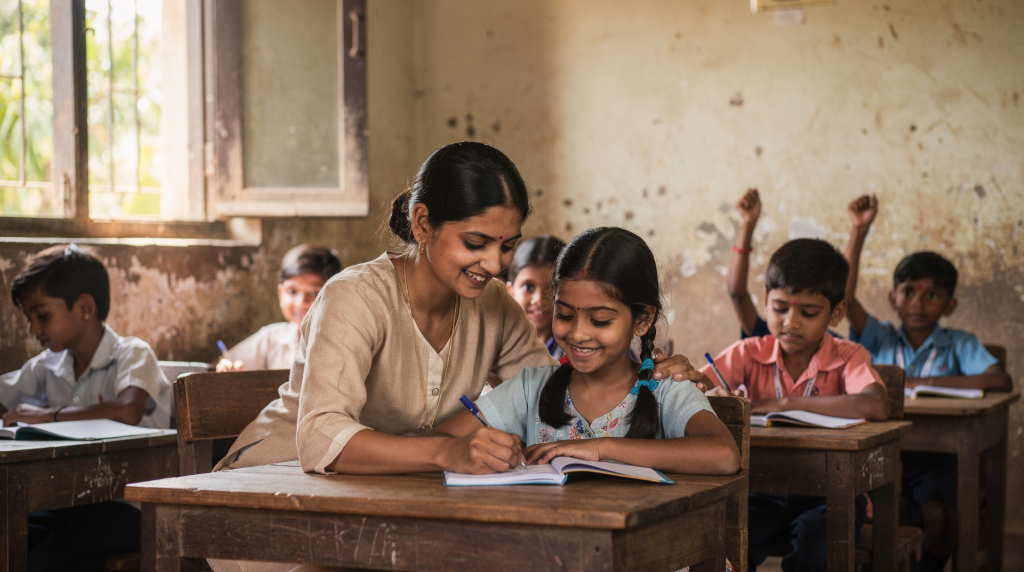
A common model is the after-school center inside a slum, village, or low-income neighborhood. Children come for homework help, foundational literacy, numeracy practice, and mentoring. These centers are especially useful where classroom sizes are large and teachers cannot give individual attention.
This model works well when children are weak in reading, writing, or arithmetic, but still enrolled in school. It also gives children a safe place to study when the home environment is crowded or unstable. I’ve walked into such centers in Mumbai’s Dharavi or Pune’s informal settlements, and the first thing that strikes you is how the center becomes a second home—a quiet, predictable space that many children lack in their own one-room tenements or temporary shelters. When a family’s housing is chaotic, the learning center often becomes the only stable anchor in a child’s day.
2. Bridge courses for out-of-school children
Some children miss years of schooling because of migration, family crisis, disability, or work. Bridge courses help them catch up so they can re-enter regular school at an age-appropriate level.
These programs often focus on:
- Basic literacy and numeracy
- Social confidence
- Age-appropriate classroom readiness
- School enrollment support
Without this step, many children simply cannot survive in a regular classroom because they are too far behind. And here’s a nuance: migration is frequently triggered by housing distress—families moving for cheaper rent, eviction, or seasonal construction work. So a bridge course is often a direct response to housing instability. The nonprofit that runs the bridge course might also be the one helping the family access a housing subsidy so the child can stay put long enough to complete the catch-up program.
3. Girls’ education programs
Girls often face extra barriers in underserved communities: safety concerns, domestic work, early marriage, menstruation-related absenteeism, and the belief that boys’ education matters more. Nonprofits tackle these barriers through scholarships, mentoring, family outreach, and life-skills education.
In many cases, the intervention is not only academic. It is also social. Girls need permission, confidence, mobility, and a support system that keeps them in school through adolescence. From a housing perspective, safety is deeply tied to the physical environment. A girl walking to school through an unlit slum or a construction site faces risks that a pucca house in a planned colony might reduce. Some nonprofits I’ve worked with have started including housing stability as part of their case management for adolescent girls—because a family that secures a permanent home under a government scheme is far less likely to pull a daughter out of school for early marriage or domestic work.
4. Digital learning and digital literacy
The digital divide became more visible after remote learning expanded. Many children in underserved households do not have a smartphone, reliable internet, or a quiet place to study. Nonprofits respond with computer labs, digital buses, mobile learning units, device access, and basic digital training for students and parents.
Digital literacy matters because education is no longer limited to textbooks. It also affects access to forms, exams, government services, and future jobs. But think about the housing angle: a digital lab in a community center is useless if the child’s family is evicted and has to move across the city. And a smartphone provided by a nonprofit won’t help if there’s no electricity in the temporary shelter. That’s why I always advise education nonprofits to map housing stability alongside digital access. The two are intertwined.
5. School strengthening and infrastructure support
Some nonprofits improve schools directly by helping with:
- Toilets and drinking water
- Classrooms and furniture
- Learning corners and libraries
- Science or activity-based learning materials
- Safety and hygiene systems
These changes may look basic, but they can strongly affect attendance, dignity, and learning outcomes, especially for girls and younger children. Yet even a beautifully renovated school won’t retain a child whose family sleeps on a railway platform. I’ve seen government schools in resettlement colonies thrive precisely because the housing was secure—families had a permanent address, children enrolled and stayed. Infrastructure support works best when paired with housing stability.
6. Inclusive education support
Children with disabilities often face the steepest barriers. Nonprofits may provide assistive devices, home-based learning, special educator support, or mainstream inclusion pathways. This work is essential because exclusion often begins early and becomes permanent if no intervention happens. Housing plays a role here too: a child with a mobility impairment needs a ground-floor home or a ramp; a child with a learning disability needs a quiet corner to focus. When nonprofits coordinate with housing agencies or help families apply for disability-friendly housing modifications, the educational intervention becomes far more effective.
Examples of nonprofit approaches in India
Different organizations use different methods, but the patterns are consistent.
| Program type | What it solves | Best suited for |
|---|---|---|
| After-school learning centers | Learning gaps, homework support, confidence | Children already in school but falling behind |
| Bridge courses | Interrupted schooling, re-entry into school | Out-of-school children |
| Girls’ education initiatives | Dropout risk, safety, social barriers | Adolescent girls and low-income families |
| Digital literacy programs | Tech access gap, online learning gap | Rural and low-income students |
| School transformation projects | Poor infrastructure, weak learning environment | Government schools in underserved areas |
| Inclusive education models | Disability-related exclusion | Children with special learning needs |
Well-known education nonprofits in India often combine several of these approaches rather than relying on just one. And the ones I respect most are those that also ask, “Where does this child sleep at night?” and connect the dots to housing support.
How nonprofits create lasting change
The best education nonprofits do not work only with children. They also work with the people and systems around them.
They engage families
Parents may not be able to support homework, understand school processes, or see long-term value in continued education. Nonprofits often explain why attendance matters, how to track progress, and how to handle issues like dropout risk or early marriage. But engagement also means recognizing that a parent stressed about eviction or struggling to pay rent cannot focus on a child’s report card. I’ve seen community workers sit with families and help them fill out housing subsidy forms alongside school admission forms. That dual support builds trust and keeps the child in school.
They support teachers
In many underserved areas, teachers need training, classroom aids, or volunteers to manage learning gaps. Nonprofits can provide teaching support, lesson plans, and student tracking systems. When teachers know that a child’s erratic attendance is due to housing instability, they can respond with empathy and flexibility—perhaps by sending work home or connecting the family to a shelter-based learning program.
They build local ownership
Programs last longer when community leaders, school management committees, and local volunteers are involved. If everything depends on outside staff, the impact is fragile. Local ownership also means that housing issues get flagged early. A community volunteer who knows which family is about to be displaced can alert the nonprofit, and together they can intervene before the child drops out.
They track progress
Strong nonprofits measure reading levels, attendance, retention, grade progression, and transitions to higher education or work. This is important because attendance alone does not prove learning. I would add housing stability as a key indicator to track. A child who moves three times in a year will show learning gaps that no amount of tuition can fix unless the housing situation is addressed.
Practical benefits for children and families
When nonprofit education programs work well, the effects go beyond exam scores.
- Children stay in school longer
- Dropout rates fall
- Literacy and numeracy improve
- Girls are more likely to continue after puberty
- Parents become more involved in schooling
- Children gain confidence and social skills
- Teenagers have better pathways to college or work
For families living on tight budgets, even small support—books, tutoring, or transport help—can change whether a child remains in school. But here’s the deeper truth: when a family also secures stable, affordable housing, all these benefits multiply. A child who doesn’t have to worry about where they’ll sleep tonight can finally focus on the algebra problem in front of them.
What makes an education nonprofit effective
Not every program creates real change. A strong nonprofit usually has these features:
- It targets a clearly defined need
- It works in the local language and context
- It measures learning, not just participation
- It coordinates with schools and communities
- It adapts when children’s needs change
- It does not treat one-time donations as a full solution
- It has a long-term view of retention, learning, and transition
A weak program may look active but fail to change outcomes. For example, giving notebooks without solving attendance or comprehension gaps will not move a child forward. And from a housing lens, an effective nonprofit recognizes that a child’s learning trajectory is inseparable from the family’s housing trajectory. It either builds partnerships with housing organizations or trains its staff to help families access government schemes like PMAY, rental vouchers, or slum rehabilitation programs.
Common challenges nonprofits face
Education work in underserved areas is demanding. Some of the biggest challenges are:
- Irregular attendance due to migration or family work
- Resistance from families who need children to earn
- Language barriers in multilingual regions
- Shortage of trained teachers and volunteers
- Limited internet or electricity for digital tools
- Dropouts during adolescence, especially among girls
- Poor coordination between school systems and community programs
These challenges explain why simple interventions are rarely enough. Education support has to be persistent and context-aware. And I would add one more challenge that doesn’t always make the list: housing insecurity. It’s the reason a child disappears from the learning center mid-year, or a bright girl suddenly stops coming because her family moved to a cheaper room in another ward. Nonprofits that don’t factor in housing are often puzzled by sudden dropouts; those that do, plan for them.
How to judge whether a nonprofit education program is credible
If you are a parent, donor, volunteer, or community partner, use this quick checklist:
- Does the nonprofit explain the exact problem it is solving?
- Does it show outcomes, not just activity photos?
- Does it work with local schools or communities?
- Does it have clear eligibility criteria for support?
- Does it mention how long the intervention lasts?
- Does it share how learning progress is tracked?
- Does it address barriers beyond tuition, such as attendance, gender, or digital access?
If the answer is “yes” to most of these, the program is more likely to be meaningful. I’d add one more question: does the nonprofit consider the child’s housing situation? A credible program will at least ask where the child lives, whether the family has a stable roof, and how housing instability might affect school participation. It doesn’t need to become a housing agency, but it should be able to refer families to the right resources.
Step-by-step: how a nonprofit usually supports a child
- The child is identified through school, community outreach, or referral.
- The nonprofit assesses the learning gap, attendance pattern, and family context.
- The child is placed in the right support model: remedial class, bridge course, scholarship, or mentoring.
- The organization works with parents and teachers to reduce dropout risk.
- Progress is reviewed regularly through tests, attendance records, or classroom observation.
- The child transitions to the next stage, such as mainstream school, higher grades, or skill training.
In my experience, step two should always include a quiet housing assessment. Is the family in a stable rental? Are they at risk of eviction? Do they own their home? The answer shapes everything that follows. A child in a transitional shelter may need a different support timeline than one in a permanent home. And step four works best when the nonprofit can help the family access housing subsidies or legal aid if needed—because a parent fighting an eviction notice cannot prioritize a parent-teacher meeting.
What communities can do alongside nonprofits
Nonprofit support is strongest when families and communities participate.
- Keep attendance steady
- Follow up when a child misses class
- Create a quiet study space where possible
- Encourage girls to continue after puberty
- Ask schools about learning gaps early
- Support local volunteers and learning centers
- Share information about scholarships and assistance
Even when resources are limited, active community involvement improves results. Communities can also advocate for housing stability as an education strategy. When a slum rehabilitation project is delayed, or a rental housing scheme is poorly implemented, it’s the children who suffer most. Community groups can push for faster processing of housing applications, monitor displacement, and ensure that every child in a temporary shelter gets linked to a learning center. Housing and education are not separate silos—they’re two sides of the same coin.
Conclusion
Nonprofit organizations play a vital role in education for underserved Indian communities because they address the barriers that keep children from learning, not just from enrolling. Their work ranges from remedial classes and bridge courses to girls’ education, digital literacy, school improvement, and inclusive support. The most effective nonprofits combine direct learning support with family engagement and community trust, creating a path that helps children stay in school and build a stronger future. But after a decade of working at the intersection of community development and housing, I’m convinced that no education program can reach its full potential unless it acknowledges the elephant in the room: housing instability. A child who moves every few months, who studies by streetlight, or who worries about where the family will sleep next week cannot learn effectively. The nonprofits that truly transform lives are those that see the whole picture—and help families find a stable door to call their own.
FAQ
What is the main role of nonprofits in education?
They help underserved children access school, stay enrolled, and improve learning through direct support, community outreach, and school-based programs. Increasingly, they also connect families to housing resources, because stable shelter is a prerequisite for consistent education.
Do nonprofits only provide tuition classes?
No. Many also provide scholarships, digital tools, school infrastructure support, girls’ education programs, bridge courses, and parent engagement. Some also assist with housing referrals or help families apply for government housing schemes, knowing that a child’s learning environment starts at home.
Why are nonprofit education programs important in rural India?
They help fill gaps where schools, transport, digital access, or family resources are limited, especially in remote and low-income areas. In rural settings, housing may seem more stable, but seasonal migration for work often disrupts schooling, making bridge courses and flexible learning models essential.
How do nonprofits help girls stay in school?
They often provide mentoring, family counseling, safety support, scholarships, hygiene support, and life-skills education. When housing is insecure, girls are at higher risk of being pulled out for domestic work or early marriage; nonprofits that address housing stability can significantly improve retention.
What is a bridge course?
A bridge course helps children who missed school catch up so they can re-enter regular classes at a suitable level. These courses are often critical for children whose education was interrupted by housing displacement or family migration.
How can someone tell if an education NGO is effective?
Look for clear goals, measurable outcomes, local partnerships, and evidence that the program improves attendance, learning, or retention over time. Also check whether the NGO considers housing stability as part of its child support strategy—it’s a strong indicator of a holistic, realistic approach.